


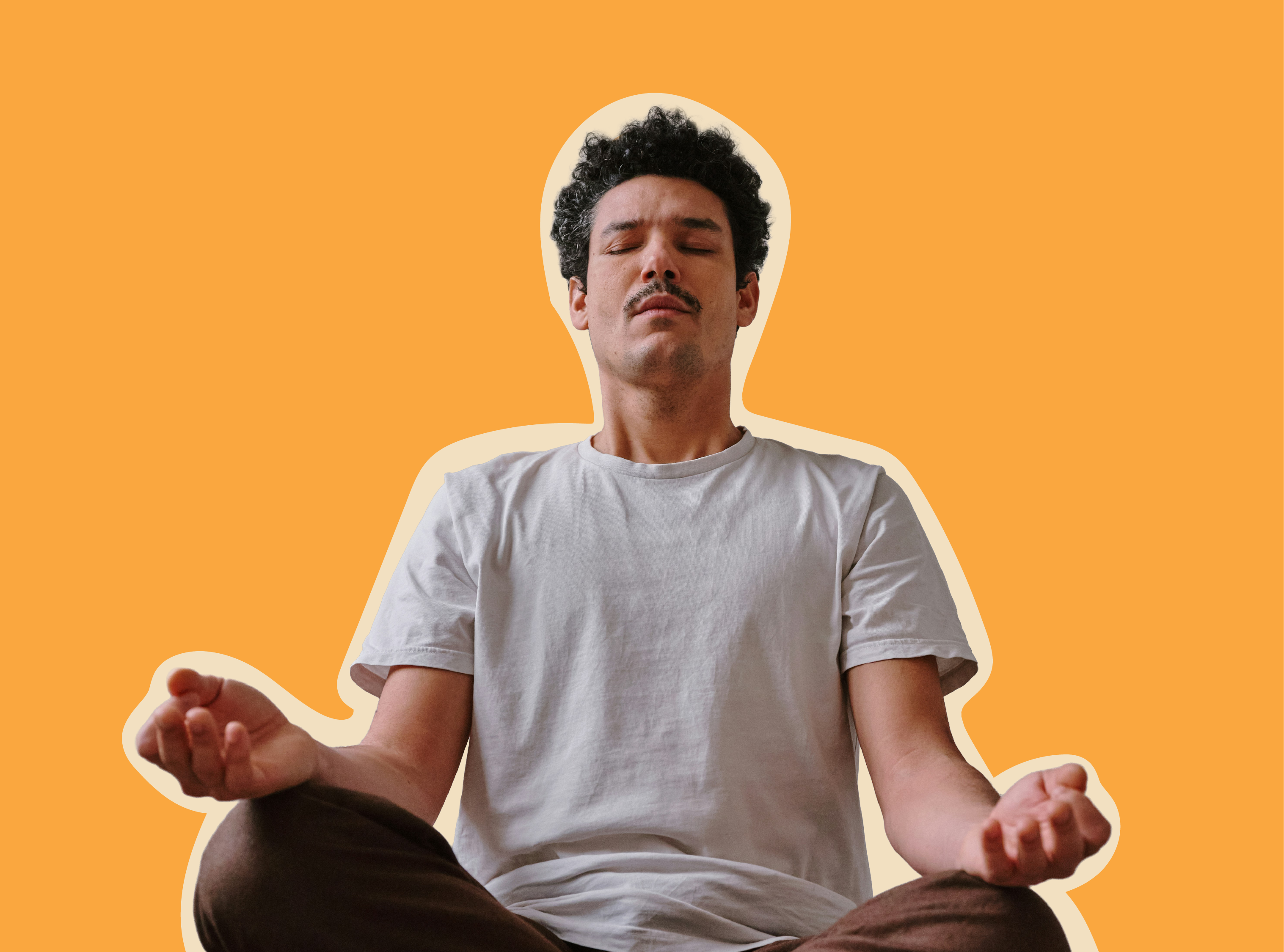
Think of the last time you ate a meal on the floor. Perhaps it was a wedding lunch served on banana leaves, a puja in someone’s home, or a Sunday at home when reading at the dining table felt too formal. Now think about how you got up afterwards. Did you push off the ground with one hand, reach for a knee, grab the edge of the bed? Or did you uncross your legs and rise?
That small moment is the basis of a test Claudio Gil Araújo, a Brazilian sports medicine physician, has used at his clinic in Rio de Janeiro for years. The sitting-rising test asks you to lower yourself into a cross-legged seat on the floor and then stand again, using as little support as you can. You start with ten points and lose one for every hand, knee or forearm you lean on. In 2012, Araújo’s team published results from 2,002 adults aged 51 to 80 who took the test and were followed for around six years. Each extra point was associated with a 21% lower risk of dying from any cause over that period.
Set the mortality figures aside and what the test measures is familiar. Getting down to the floor and back up takes leg strength, hip mobility, balance and some coordination, the same combination you use to climb into an auto, step down from a train or sit with friends on a terrace until late. Most conversations about muscle are about how it looks in a mirror or a photograph. Research on ageing measures it in a more useful currency: how easily and happily you move through a day, whether that means the stairs to a friend’s flat, a crowded market with a full bag, or the dance floor at a cousin’s wedding.
Across much of India, life has long been organised close to the ground, with meals, prayer, conversation and rest all happening at floor level. Chairs, desks, and car seats have moved much of that upward, and the muscles that once got a daily workout from sitting and rising now get very little. The cost shows up over time. In one study of older adults living at home, each extra hour of daily sitting was linked to a 33% higher risk of sarcopenia, the age-related loss of muscle mass and strength, independent of how much exercise people did. A 2020 study of more than 14,500 adults over 65 in six countries, India among them, also linked more time spent sedentary to sarcopenia. Both studies capture a single moment, so they show a link and leave cause open, and they point in the same direction.
In many Indian families, getting older comes with an instruction to rest. Retirement is treated as a cue to slow down, and adult children, out of love, take over the stairs, the shopping and anything heavy. ‘Aaram karo’ is offered as kindness and often received as permission, and a body that is asked to do less soon finds it can do less. The Hadza of Tanzania, among the last hunter-gatherers on Earth, offer a different picture. By one research team’s measure, they spend about 75 minutes a day in moderate to vigorous activity, and anthropologist David Raichlen has noted that those levels hold up into old age, suggesting that slowing down with age is a feature of how we live. The World Health Organization’s 2020 guidelines moved in the same direction, shifting their emphasis from formal exercise towards active living and advising older adults to replace time spent sitting with movement of any intensity.
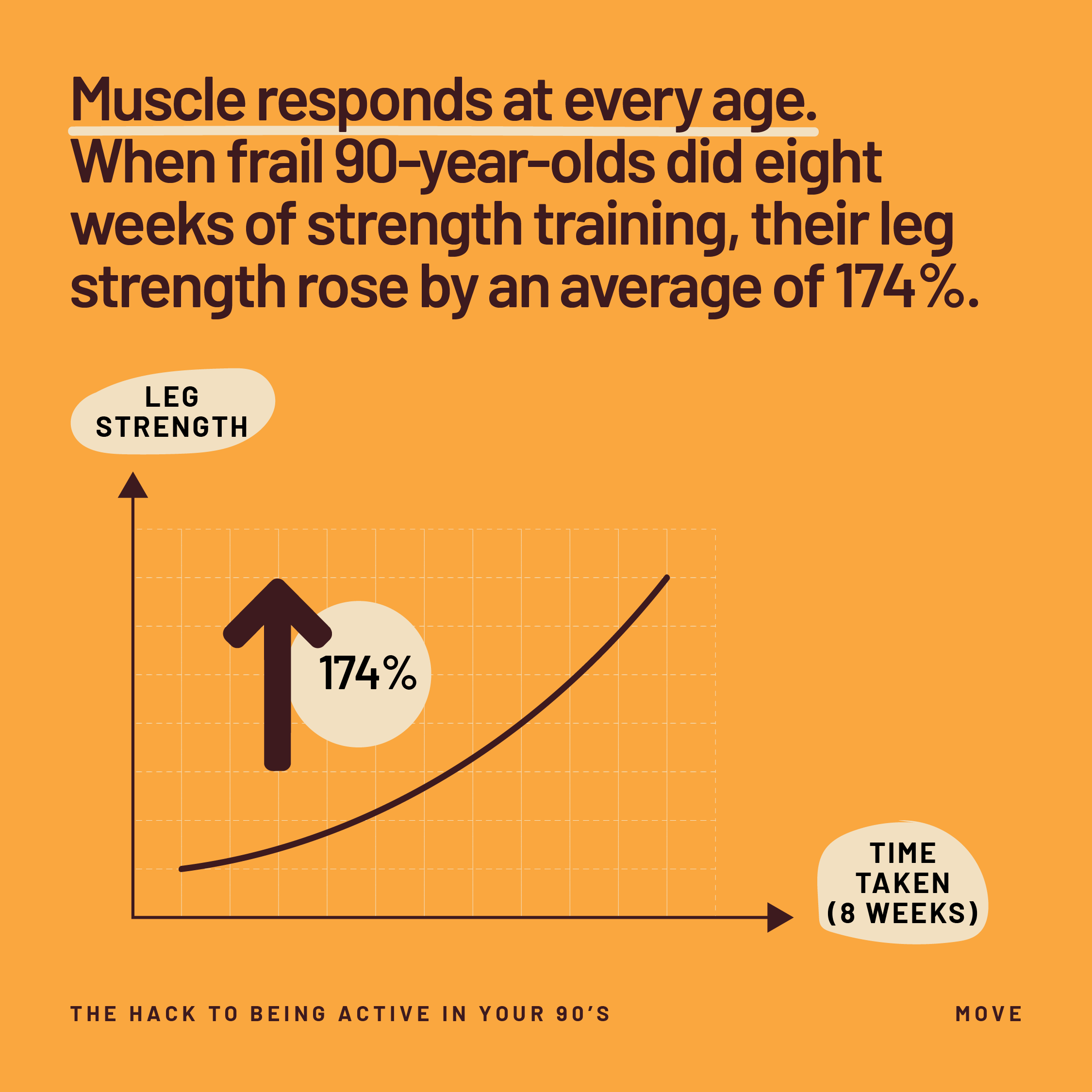
In 1990, a team led by Maria Fiatarone in Boston put ten frail nursing-home residents, average age 90, on an eight-week programme of heavy resistance training for their legs. The oldest was 96. At the time, many doctors assumed strength at that age was largely gone for good, and that lifting heavy weights would be dangerous. By the end of the programme, the nine participants who completed it had increased their leg strength by an average of 174%. Their thigh muscles grew, and their walking speed improved by nearly half. The study was tiny, but it changed how researchers thought about ageing muscle, and much of the work since has built on it.
It also offers a gentler way to read the numbers that circulate about muscle loss. You will often hear that adults lose somewhere between 3 and 8% of their muscle mass every decade from their thirties or forties, with the pace picking up after 60. Those figures are rough, and they describe what tends to happen to people who don’t use their muscles much. The Boston residents showed how much of that decline can be reversed once the body is asked to work.
Three everyday measures
Researchers have found a few other ordinary abilities that track closely with how well people age, and each lines up with something you already do.
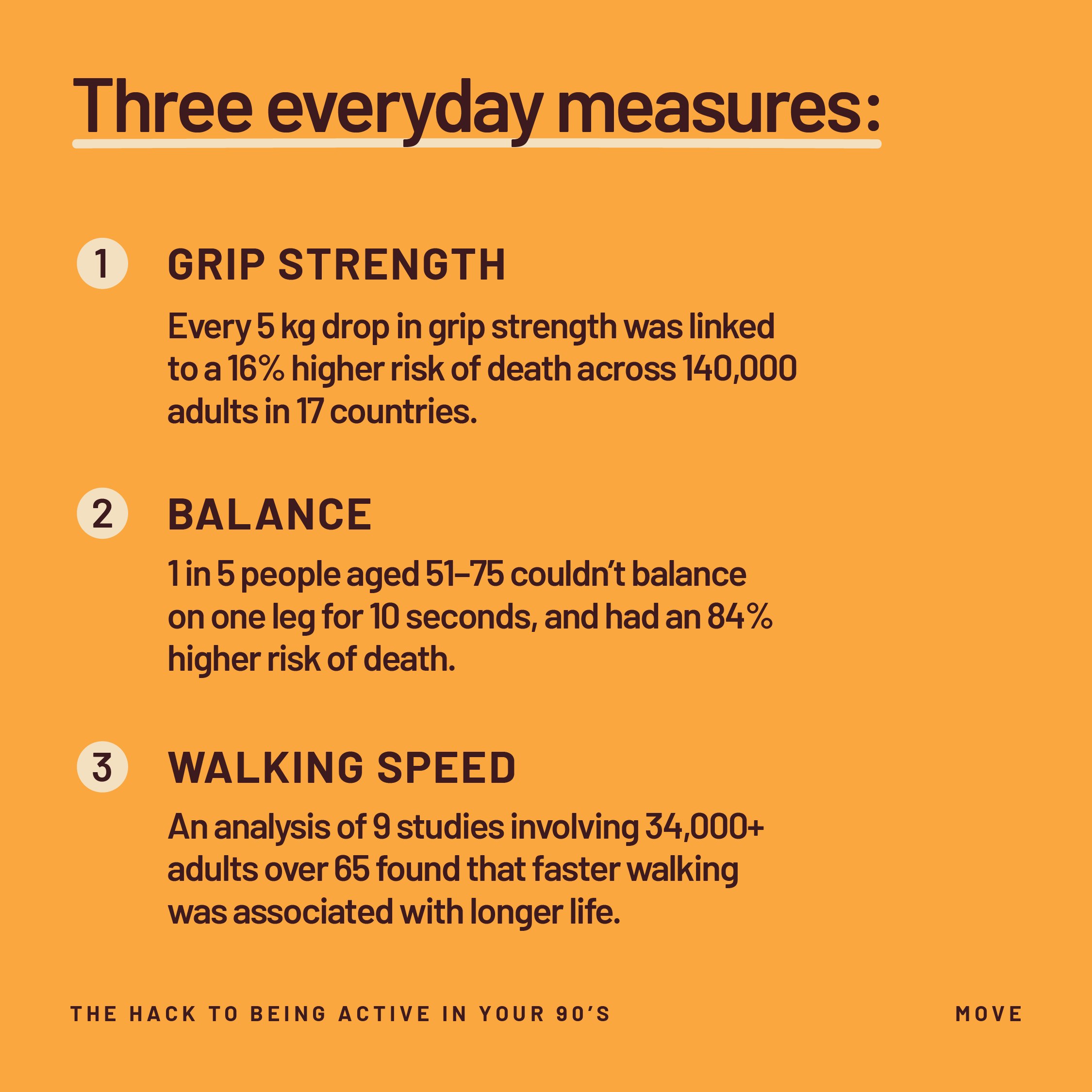
The first is grip.
The Prospective Urban Rural Epidemiology study measured hand strength in nearly 140,000 adults aged 35 to 70 across 17 countries and found that every 5 kg drop in grip strength was associated with a 16% higher risk of death from any cause over about four years. Grip turned out to be a stronger predictor than blood pressure. The study’s lead author, Darryl Leong, was careful to say it remained to be tested whether building strength would lower that risk, so grip is best read as a sign of overall strength. In daily terms, it is what lets you carry two full bags back from the market, lift a heavy kadhai off the stove, open a stubborn jar of pickle and hold on to the rail of a crowded bus.
The second is balance.
In 2022, Araújo’s group asked 1,702 people aged 51 to 75 to stand on one leg for ten seconds without support. About one in five couldn’t, and after accounting for age, sex and existing health conditions, that group had an 84% higher risk of dying during the follow-up period. Araújo has pointed out that we stand on one leg far more often than we notice, every time we climb a step or swing out of a car.
The third is how fast you walk.
A 2011 analysis of nine long-running studies, covering more than 34,000 adults over 65, found that people who walked faster tended to live longer, with survival improving steadily across the full range of speeds. Much of that pace comes from the lower leg. The calves push you forward with each step, and beneath the larger calf muscle sits the soleus, a broad, flat muscle built for long hours of work. At the front of the shin, the tibialis anterior lifts the front of your foot as you step, which stops your toe from catching on a doorstep or uneven pavement.
The soleus has a second talent. (Don’t say we didn’t tell you! This microhabit is a keeper.) In a 2022 University of Houston study, a movement called the soleus pushup, raising the heels while seated with the front of the foot on the floor, cut the rise in blood sugar after a glucose drink by 52% and lowered insulin by 60%, with the muscle working for hours without tiring. It was a single lab study, and the results need testing at scale, but the movement can be done at a desk, in a train seat or in front of the television.
The grip, balance and walking findings come from observational studies, which show associations and leave cause and effect open. The Fiatarone study is why we can take them as encouragement.
Practising for life, for later
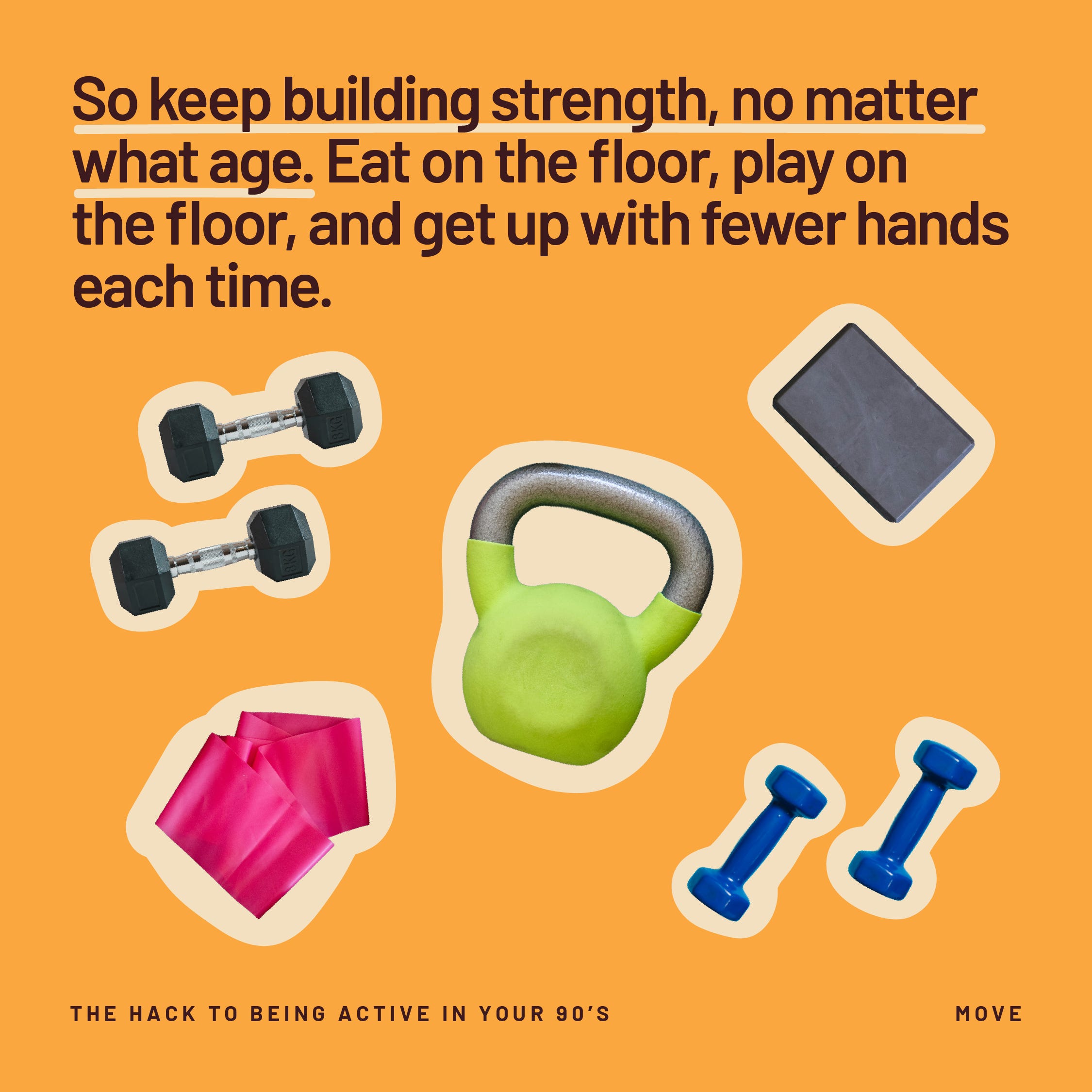
The WHO recommends muscle-strengthening activity on at least two days a week for adults, and for people over 65, activity that combines balance and strength on three or more days. That can mean weights at a gym, resistance bands at home, or bodyweight work such as squats and step-ups. Smaller habits help too, and most of them fit into the day you already have.
Spend some time on the floor again. Eat a meal there, read there, sit with a child or a dog there, and practise getting up with fewer hands each time. Stand on one leg while the chai comes to a boil, then switch, and walk on your heels across the kitchen while you wait for the pressure cooker. Carry your shopping with a bag in each hand to keep things even. Get up from your chair regularly, and do a set of soleus pushups when you can’t. Walk somewhere you want to be, at a pace brisk enough that talking takes a little effort, and take the stairs when there’s a choice.
The researchers measured these abilities to predict death, which makes for alarming headlines. Seen from the floor at the end of a long Sunday lunch, they look more like the things that will let you get up unaided, carry the dishes back to the kitchen and head out for an evening walk for as long as you like.
1,000 Ways to Live Well is a Mille publication. Mille is a modern nutrition brand built around everyday rituals, starting with protein that doesn't ask you to compromise on taste. millesupergrain.com