

Sleep needs a runway
On melatonin, lighting, and why your nervous system can't take off from a car park: Things to do between dinner and bed that could help you sleep better, longer, deeper.


It is 11pm. You are exhausted in that bone-deep way that accumulates across a full day, you finally get into bed, and your brain immediately decides this is the perfect moment to replay that one conversation from 2019 in excruciating detail, run through tomorrow’s to-do list with real thoroughness, and also, now that you mention it, remember the awkward thing you said in that meeting last Tuesday. Alternatively (and this is somehow worse) you fall asleep fine and wake at 3am fully alert, staring at the ceiling while your partner snores peacefully beside you as if sleeping is the easiest thing in the world.
You are not bad at sleeping. You are probably just allowing the hours leading up to it to work against your own biology, which is extremely easy to do because modern life is essentially structured to prevent good sleep, and nobody told us.
Before electricity, when the sun set, the pace of life dropped with it. Work ended, candles were lit, conversations slowed, and the body had time to register that the night was arriving and could start winding down accordingly. Now we are answering emails at 10pm under overhead lighting, watching shows specifically engineered to keep us anxious and engaged, refreshing a news cycle that would spike anyone’s cortisol, and then lying down and wondering why our nervous system has not received the memo. Sleep needs a runway. We have been trying to take off from a car park.
Give in to transition
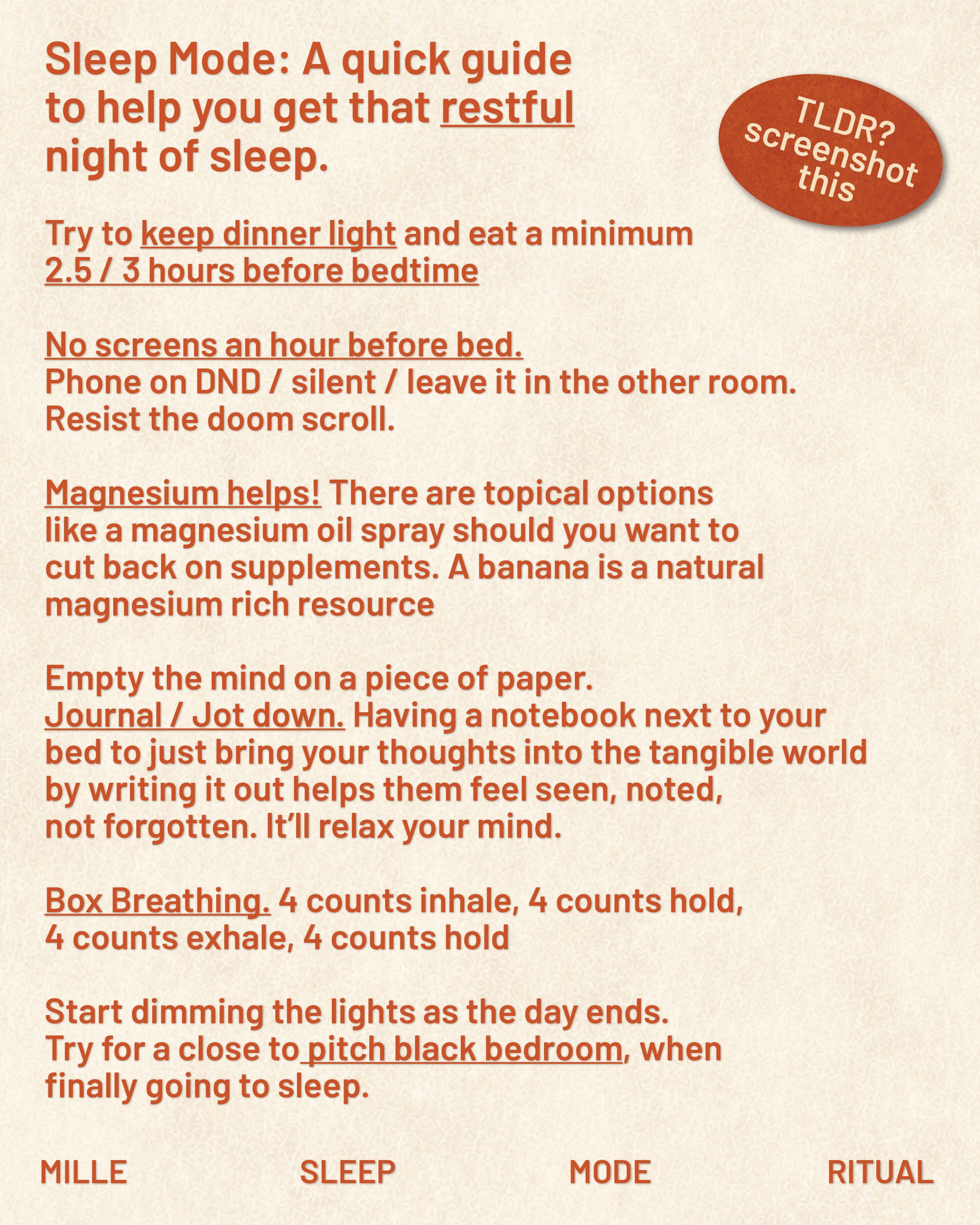
The single most useful thing you can do is start winding down an hour or two before bed. Sounds obvious, but is surprisingly hard in practice because a transition requires us to stop, and stopping is a skill most of us have let atrophy. Dim the lights, and mean it: warm-toned lamps (actual candlelight if you are hardcore), blackout curtains, electrical tape over the blinking LEDs on your charging points… that last one sounds like a small thing, but you’d be surprised how much these bits of residual light add up. Your bedroom should feel like a sanctuary, not a sanatorium, which means cool air, crisp sheets, and as close to pitch-black as your living situation allows.
Put the phone in another room if you can, or set it to silent in the same room. Swap whatever you are watching for something that does not require your nervous system to stay on high alert. Read, stretch, sit with something warm. A brief repeated ritual trains the body to associate those cues with calm, and over time, you will find yourself getting sleepy earlier, which feels like a loss and is actually a win.
Sort out your lighting situation
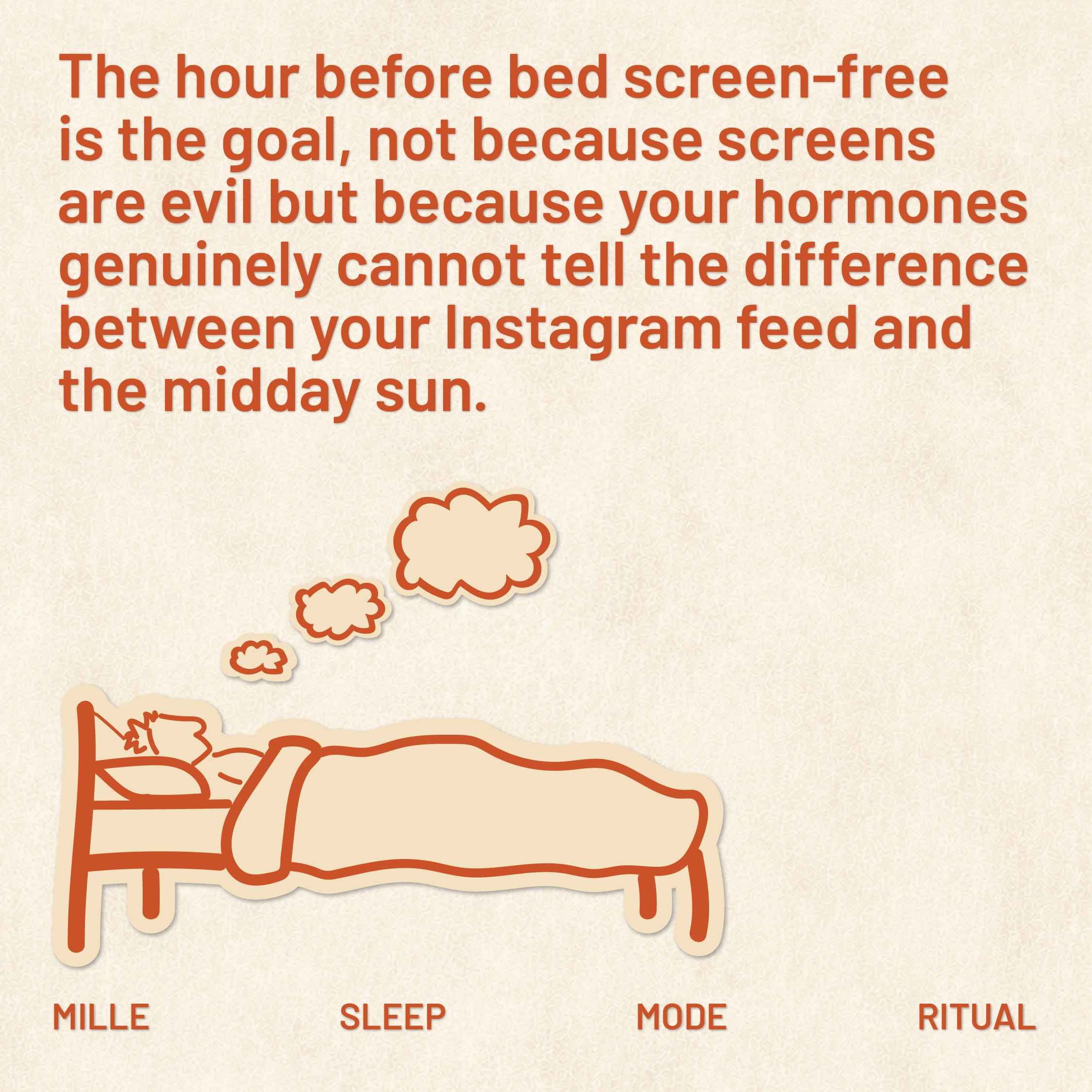
Light runs our biology more than most people realise. As daylight fades, your body depends on a drop in light exposure to trigger melatonin production, the hormone that tells your brain it is safe to rest. Blue light from screens is particularly disruptive because it tells your brain it is still afternoon: melatonin stalls, sleep onset delays, and you lie in bed physically exhausted but mentally refusing to land. The hour before bed screen-free is the goal, not because screens are evil but because your hormones genuinely cannot tell the difference between your Instagram feed and the midday sun.
Eat earlier and lighter than you think you need to
Sleep and digestion are not natural allies. A large or heavy meal late at night raises your core temperature and delays the internal cooling that is essential for falling and staying asleep, which is why finishing dinner at least two to three hours before bed makes a meaningful difference. The lightest meal of the day is best saved for the evening rather than the beginning of it. A banana before bed is genuinely useful, not folk wisdom: rich in magnesium, potassium, and tryptophan, which converts into melatonin and serotonin, it is one of the better things you can eat if you are prone to waking in the night.
About alcohol: yes, it helps you fall asleep, and no, that is not the same as good sleep. It fragments your sleep architecture and reduces REM, which means you can clock eight hours and still wake up feeling like something went wrong, because something did. An ashwagandha tea or warm water with honey and lime is a better end to the evening than you expect it to be, and ashwagandha specifically works on the GABA receptors in the brain, quieting the signals that keep stress responses running. Organic India does a good one.
Work on your nervous system before you ask it to switch off
Stress is one of the most reliable sleep disruptors, and by the time you get into bed, your nervous system is often still humming with the residue of the day in a way that lying in the dark does nothing to resolve. Box breathing works on a physiological level and takes about five minutes: inhale for a count of four, hold for four, exhale for four, hold for four, repeat until you feel your shoulders drop. This activates the parasympathetic nervous system and signals your brain that there is no emergency, nothing to solve right now, and that it is permitted to stand down.
Magnesium helps here, too. Topical magnesium oil sprayed generously over the body before bed is one of the more underrated things in this space: it relaxes tense muscles, calms the nervous system, and is easily found on Amazon. It can be slightly tingly at first, but you get used to it.
And speaking of feet: in Ayurveda, the soles of the feet are considered particularly significant, dense with nerve endings and marma points, the pressure points through which the body’s energy flows. A brief foot massage before sleep, with oil or a thick body butter, is one of those practices that sound indulgent but are actually insanely relaxing. Do it, put on cotton socks if the oil bothers you, and notice the difference.
One more thing, and this is so straightforward it barely needs saying: sex. The cocktail of hormones released during orgasm, oxytocin, serotonin, and prolactin, is one of the most efficient natural sedatives available. File under: non-negotiable self-care.
Write it down
The other thing that helps, so low-tech it feels silly that we’re not all doing this anyway: keep a notebook on the bedside table and jot down whatever is circling before you sleep. Tomorrow’s tasks, the worry you have been carrying since Thursday, the half-formed thought that keeps surfacing... your brain has been holding these things in working memory because it does not trust they will be remembered otherwise. Writing them down is a signal that they have been noted and can wait until morning. Add three things you are grateful for if you are open to it, not as a performance but because it genuinely shifts the brain’s attention toward what is resolved rather than what is not
Anaïs Nin wrote in her diary every night of her adult life. She said it was how she learned to capture the living moment. You do not have to be Anaïs Nin. You just have to get the contents of your head out of your head and onto paper, and then put the pen down and go to sleep.
The great news?
None of this requires a sleep coach, a weighted blanket, or a supplement that seventeen people on your feed are currently promoting. Your body already knows how to sleep; it’s been doing it your whole life. You just have to make the hours before bed look less like an obstacle course and a little more like an invitation.
1,000 Ways to Live Well is a Mille publication. Mille is a modern nutrition brand built around everyday rituals, starting with protein that doesn't ask you to compromise on taste. millesupergrain.com
 | A guest post by
|
 | A guest post by
|